
Think about someone you know who naturally takes responsibility.
When something needs to be decided, they're usually willing to step forward. They may be the person others look to for direction. They don't always need to be the loudest person in the room, either. Sometimes, their confidence simply comes from knowing what they stand for.
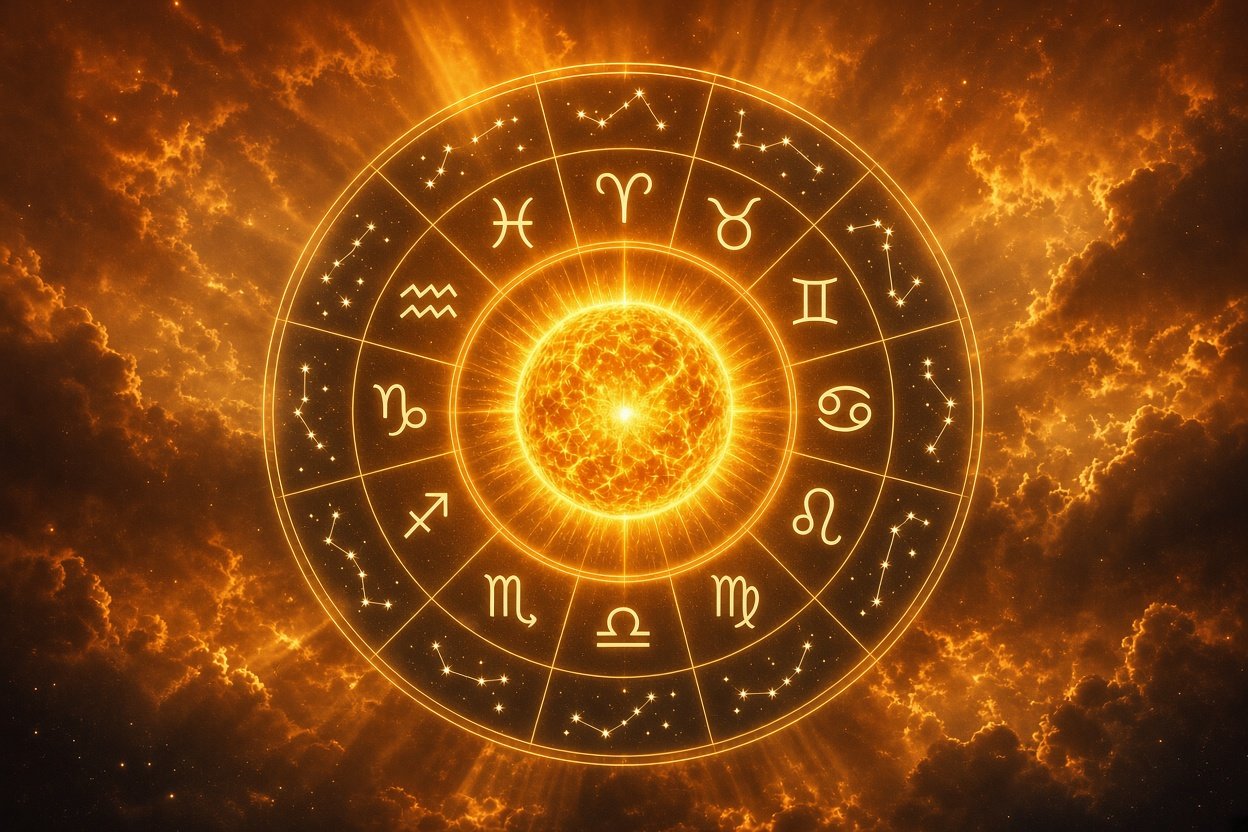
This kind of confidence, responsibility and sense of identity is closely connected with the Sun, or Surya, in Vedic astrology.
But Surya represents much more than confidence.
In Jyotisha, the Sun is traditionally associated with the self, vitality, authority, leadership, father, recognition and personal dignity.
So what does the Sun actually mean in a Vedic birth chart?
Let's look at it in simple terms.
1. Surya and Your Sense of Self
In Vedic astrology, the Sun is known as Surya.
It's considered an important graha in Jyotisha. The word graha is an astrological term and doesn't mean exactly the same thing as the modern astronomical word “planet.”
Astronomically, the Sun is a star at the centre of our solar system.
Earth revolves around it, and the Sun provides the light and heat that support life on Earth.
Vedic astrology gives the Sun a symbolic meaning based on its light, strength and central place in our sky.
Traditionally, Surya is associated with:
-
Self and individuality
-
Vitality
-
Consciousness
-
Confidence
-
Willpower
-
Leadership
-
Authority
-
Recognition
-
Personal dignity
-
Purpose
A simple way to think about it is this:
The Sun represents how you stand in your own identity.
It can be connected with the qualities you consciously express and the sense of purpose that helps you move forward.
The Sun and confidence
When astrologers talk about the Sun, confidence often comes up.
But confidence doesn't always mean being outgoing.
It can mean:
-
Trusting your own decisions
-
Taking responsibility
-
Standing up for yourself
-
Having self-respect
-
Being comfortable with your identity
-
Taking the lead when necessary
Traditionally, a strong Sun can be associated with leadership, confidence and a willingness to take responsibility.
On the other hand, a challenged or afflicted Sun may be interpreted through themes such as low confidence, difficulty with authority, excessive pride or a strong need for recognition.
That's why the Sun shouldn't simply be labelled as “good” or “bad.”
Its meaning depends on the rest of the chart.
2. The Sun, Father and Authority
Surya isn't only about your personal identity.
In traditional Vedic astrology, the Sun is also a significator of the father.
Astrologers may consider the Sun when looking at themes connected with:
-
Father
-
Paternal influence
-
Authority figures
-
Leadership
-
Government
-
Status
-
Recognition
-
Responsibility
This doesn't mean that the Sun alone can tell you everything about your father or your relationship with him.
A Vedic birth chart is much more detailed than that.
Astrologers traditionally look at several factors together before drawing conclusions.
Why is the Sun connected with authority?
It's helpful to think about everyday situations.
A manager has to make decisions.
A government officer has responsibilities.
A team leader has to guide others.
A person in charge of a family matter may need to take responsibility when others aren't sure what to do.
These situations involve authority, responsibility and leadership.
Those are all themes traditionally connected with Surya.
The Sun is therefore associated with:
-
Leadership
-
Government
-
Administration
-
Senior positions
-
Responsibility
-
Recognition
-
Influence
-
Authority
A well-placed Sun is traditionally associated with confidence and the ability to take responsibility.
A difficult Sun placement may be interpreted through struggles involving authority, recognition, confidence or pride.
Again, these are traditional astrological interpretations, not scientific predictions.
The Sun and health symbolism
Surya is also traditionally associated with vitality and physical strength.
Traditional astrological texts connect the Sun with themes such as:
-
Life force
-
Physical constitution
-
Body heat
-
Heart
-
Bones
-
Eyes, particularly the right eye in some traditional systems
These are astrological correspondences.
They aren't medical diagnoses.
If you're concerned about your health, a qualified medical professional is the right person to consult.
3. Your Sun's Sign Isn't the Whole Story
This is one of the most useful things to understand about Vedic astrology.
Knowing your Sun's zodiac sign is helpful.
But it doesn't give you the complete picture.
Vedic astrologers traditionally consider several factors when interpreting Surya.
These can include:
-
The Sun's zodiac sign
-
The house where the Sun is placed
-
Its exact degree
-
Its strength
-
Other planets connected with it
-
Planetary aspects
-
Whether it's exalted or debilitated
-
Whether it's in its own sign
-
The house ruled by the Sun
So two people can have the Sun in the same sign and still have very different birth charts.
The Sun's important signs
The Sun rules Leo, or Simha.
In traditional Vedic astrology, the Sun is considered:
-
Exalted in Aries (Mesha)
-
Debilitated in Libra (Tula)
-
In its own sign in Leo (Simha)
-
In Moolatrikona in Leo, traditionally from 0° to 20°
These terms describe traditional astrological strength and dignity.
They're not statements about the physical condition of the Sun.
The Sun and houses
The house where Surya sits tells astrologers which area of life may become important when interpreting its symbolism.
Depending on the chart, astrologers may connect the Sun with themes involving:
-
Identity
-
Family and finances
-
Communication
-
Home
-
Creativity
-
Work
-
Relationships
-
Career
-
Gains
-
Spiritual matters
The exact meaning depends on the entire chart.
So it's better not to treat a statement like “Sun in this house always means this” as a complete interpretation.
Vedic astrology works through combinations.
Sunday and Surya
The Sun is traditionally associated with Sunday, known as Ravivara.
Surya also has an important place in the Indian calendar.
When the Sun moves from one zodiac sign to another, the transition is called Sankranti.
One familiar example is Makar Sankranti, which is associated with the Sun's transition into Capricorn in the traditional zodiac framework.
Astronomy and Vedic Astrology Are Different
It's worth keeping one thing clear.
The Sun's astronomical nature is something science can measure.
The Sun is a star.
Earth revolves around it.
Its apparent movement through the zodiac is related to Earth's orbit around the Sun.
Vedic astrology gives symbolic meanings to these celestial positions.
So when we say that Surya represents authority, confidence or vitality, we're describing traditional Vedic astrological symbolism.
Science hasn't established that the position of the Sun at birth causes personality traits or determines life events.
Keeping this distinction clear helps us talk about astrology honestly while still understanding its traditional meanings.
What Can Surya Represent in Your Chart?
Instead of looking at the Sun as a simple personality label, you can use its traditional meanings to explore some interesting questions.
For example:
-
How comfortable am I with responsibility?
-
How do I express confidence?
-
How do I respond to authority?
-
Do I naturally take the lead?
-
How important is recognition to me?
-
Where do I need more self-respect?
-
What role does paternal influence play in my life?
-
Where do I want to become more independent?
Your Sun placement can be one starting point for these questions.
But remember that the Sun is only one part of a Vedic birth chart.
The Lagna, Moon, other grahas, houses, aspects and planetary relationships all add context.
One Simple Tip to Try
Take a look at your Vedic birth chart and find your Sun's sign and house.
Write down:
-
Your Sun's zodiac sign
-
Your Sun's house
-
One traditional Sun quality you recognise in yourself
Then ask yourself:
“Where in my life do I naturally take responsibility, seek independence or want to be recognised?”
Don't try to force an answer.
Just think about your real experiences.
That's a simple way to start understanding what the Sun represents in Vedic astrology without reducing Surya to just one personality trait.